

Purchasing, marketing, e-commerce, analytics, and regional teams use the same supplier offers but prepare different tables. Each department opens cards, repairs fields, and forwards files in its own way. The company pays in repeated effort.
The scale of the task
A retailer with several product lines needs price, package, and availability data across departments. Working with 20 external catalogs makes scattered spreadsheets a task of their own. Before automation, agree on source access and acceptable load.
Map recurring steps: who collects, who cleans fields, and who passes results onward. Negotiations, assortment choices, and purchase decisions remain separate work. Shared collection removes duplicate data preparation, not the work of all five departments.
One collection, different outputs
Create source scenarios with agreed fields in a shared Akmelo workspace. Save supplier code, SKU, product variant, region, and collection time beside the values. Check product equivalence separately; this does not assume perfect automatic merging across all catalogs.
A schedule replaces repetitive page visits. Scenarios save records, while exports select data for each recipient. Purchasing needs one view, marketing another. Combining several sources into one file or calculating extra metrics requires explicit logic in a scenario or the receiving system.
Configure access by role and source. Run logs, record history, and sample checks help investigate errors. Akmelo prepares data; distributing management decisions and changing business systems require separate company setup.
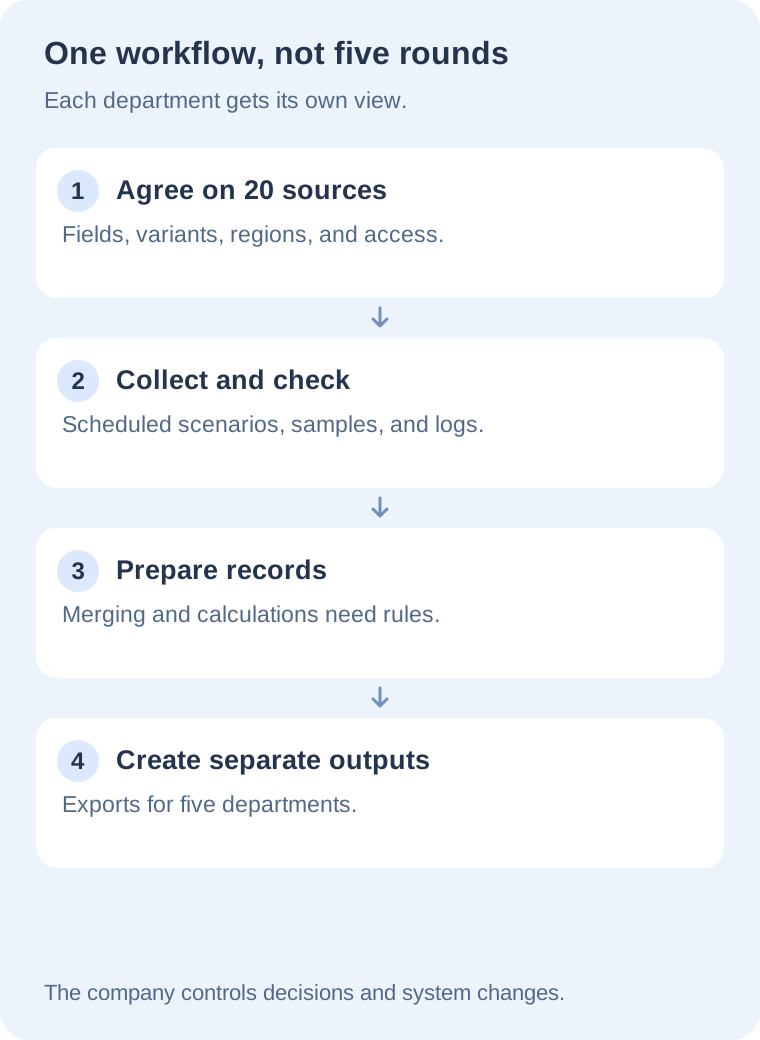 Image unavailable
Example: about 470,000 RUB per month
Add up recurring effort across departments. If five teams each spend 88 hours per month, the total is 440 hours. With 80 shared hours for maintenance, checks, and result preparation, 360 hours become available.
| Parameter | Monthly example |
|---|---|
| Repeated preparation in five departments | 440 hours |
| Shared checking and maintenance | 80 hours |
| Time made available | 360 hours |
| Estimated fully loaded hourly cost | 1,400 RUB |
| Value of time made available | 504,000 RUB |
| Service and maintenance budget | 36,000 RUB |
| Estimated effect | 468,000 RUB |
Under these assumptions, the effect is 468,000 RUB, roughly 470,000 RUB per month: 360 hours × 1,400 RUB less 36,000 RUB in recurring costs. This values time redirected to other tasks; payroll may stay unchanged. Use your actual processing and maintenance spending for your estimate.
If initial setup costs 180,000 RUB, the first month's effect is 288,000 RUB. Include downtime, source page changes, and extra checks in the budget.
Test before scaling
Start with two sources and two departments. Measure the entire path to an accepted file, including corrections. Add categories only after that. Assign an owner for field definitions and an error investigation process: team agreements matter as much as a schedule.